
Methodology and compliance
What Entend does in the courtroom, and what it never does.
This page exists so that a lawyer evaluating Entend can do real diligence in ten minutes. It describes the method, the data handling, and the design boundaries in plain language. It is not legal advice, and it does not substitute for your own jurisdiction's rules.
What it does
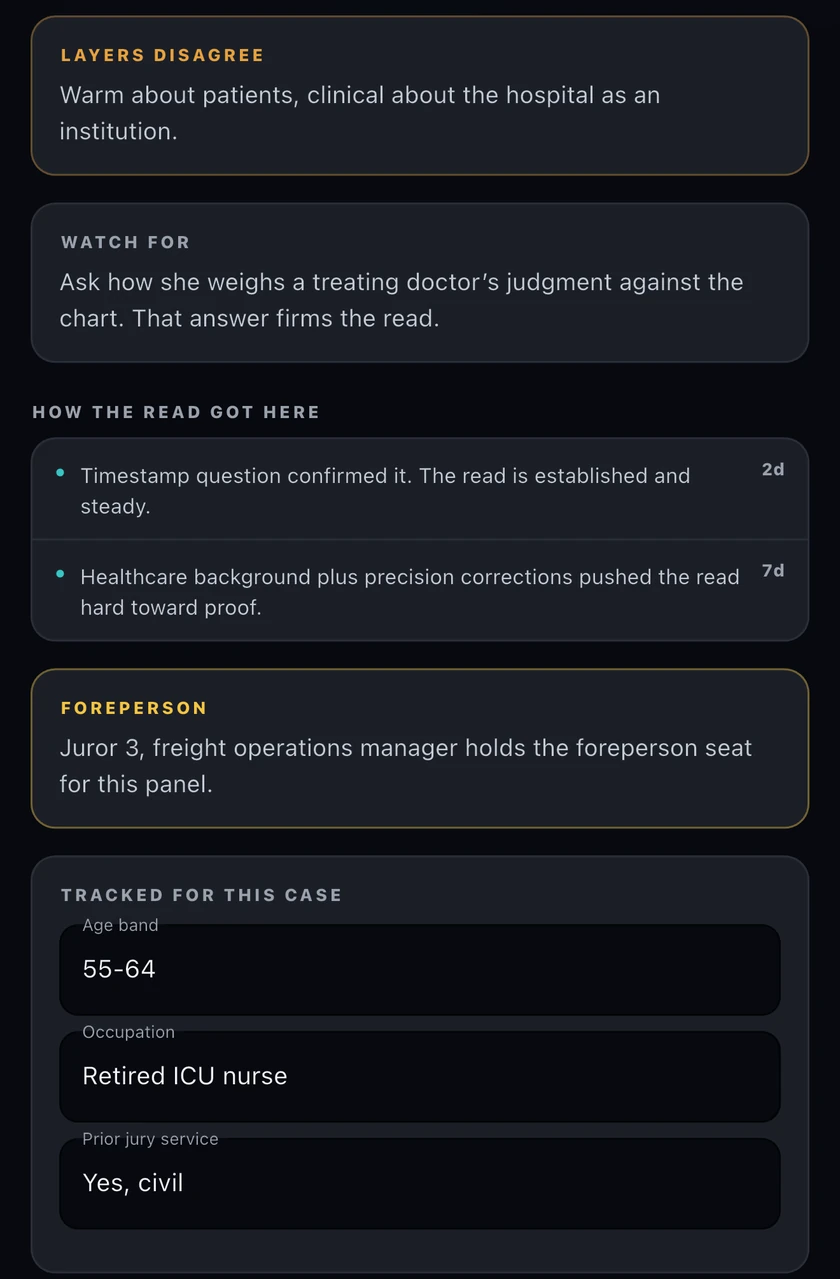
Entend is a note-taking and coaching tool for the lawyer's own courtroom observations. During voir dire, you record what you see and hear: where a juror's attention goes, how they hold themselves, the pace and shape of their answers, the questions they ask back. Entend organizes those observations, time-stamped and auditable, into a working read of how each juror takes in information, expressed as four communication preferences: how they weigh evidence, how they track order and sequence, how they relate to the people speaking, and the pace they respond to. It then suggests how to deliver your case to the room you actually have: pacing, framing, emphasis, and order. The methodology behind the read is a communication practice developed over 30 years of field work and taught in university courses.
What it never does
- No juror research. Entend performs no background research on any juror. It does not search, scrape, or monitor social media or any other source. It never connects to the internet on a juror's behalf and it never contacts anyone. The only input is what the lawyer personally observed in open court.
- No demographic scoring. Race, ethnicity, sex, age, religion, national origin, and every other protected trait are not inputs, not features, and not proxies anywhere in the read. Reads are built exclusively from observed communication behavior. This is a design boundary enforced in the software, not a policy promise.
- No verdict prediction. Entend does not predict how any juror or panel will vote, and it displays that limit inside the product: "Reads how the room communicates. Never a prediction of any verdict." It reads communication preference and prescribes delivery. Nothing else.
- No cameras on jurors, no recordings of jurors. Capture is silent, one-handed note-taking. Voice notes are the lawyer's own spoken shorthand, transcribed on the device; the audio never leaves it.
- No inner-state claims. Every read describes observed communication behavior and preference, with the evidence attached. The product refuses findings without evidence: no quote, no item.
How this maps to the professional-conduct landscape
Because Entend touches nothing but the lawyer's own in-court observations, the juror-research questions that dominate the ethics literature do not arise. There is no social-media review, so the passive-versus-active distinction (ABA Formal Op. 466) and the stricter state treatments of platform notifications are simply not implicated. There is no ex parte contact of any kind. And because no demographic or protected trait exists anywhere in the system, a lawyer using Entend's reads is not relying on a tool that scores jurors on characteristics a peremptory strike could not lawfully rest on: the concern at the center of ABA Formal Op. 517's due-diligence duty for jury-selection technology. This page, together with the in-product evidence trail, is designed to serve as the record of that diligence.
Data handling
- Case notes and reads live in your account, access-controlled to you and protected by default-deny security rules. Observer notes are anonymized within trial teams.
- AI processing runs on enterprise API terms: inputs and outputs are not used to train models. Capture works fully offline; nothing about the courtroom moment depends on a connection.
- Deleting your account deletes your data. Real delete means real delete.
The method, in one paragraph
The Entend Method treats communication as a set of observable, trainable physical and vocal choices: breath, stance, gesture, orientation, focus, and voice. Thirty years of field work produced a precise vocabulary for those choices and a disciplined way of reading them in others, including the calibration habits that keep an observer honest: evidence before conclusions, no single observation treated as proof, and reads that sharpen over days instead of snapping to judgment. Entend is that discipline, in software, in your pocket.
Questions, or diligence requests from your firm or bar association: hello@entend.ai